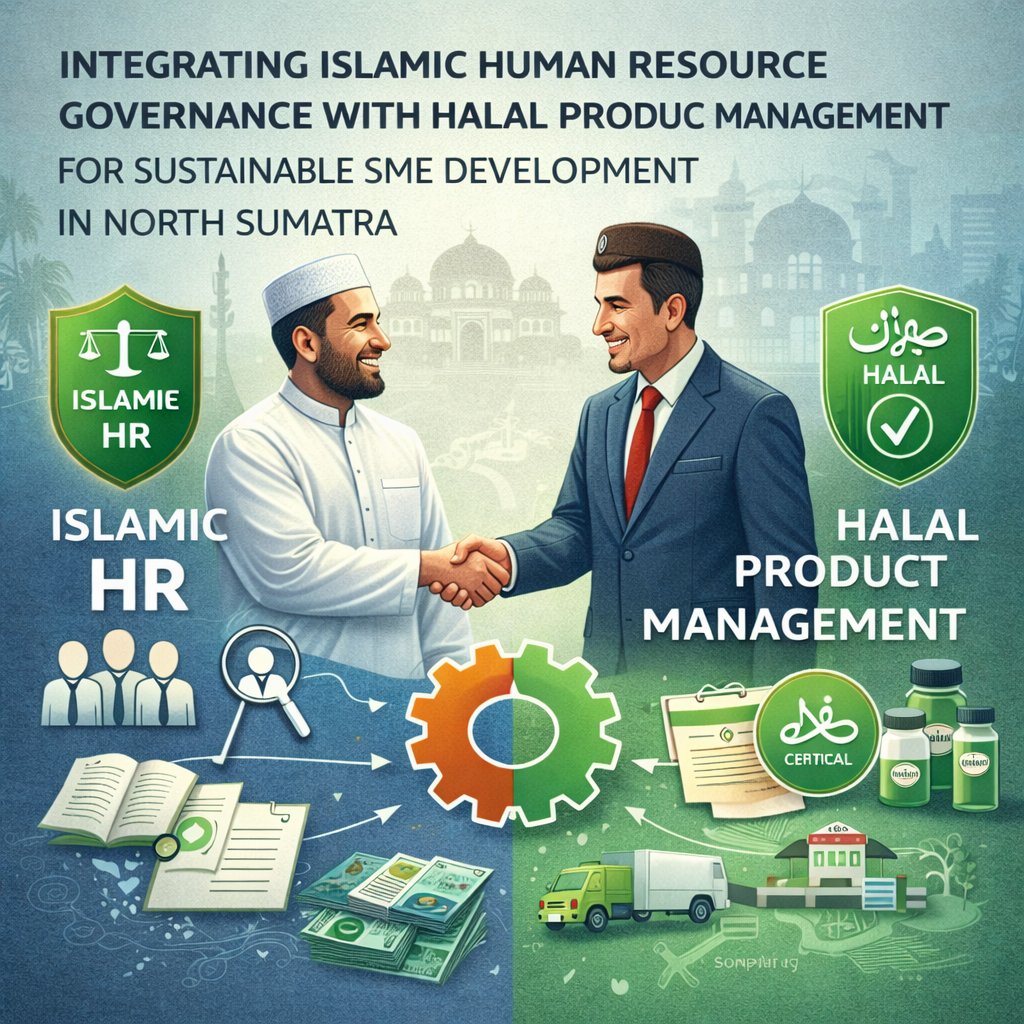
INTEGRATING ISLAMIC HUMAN RESOURCE GOVERNANCE WITH HALAL PRODUCT MANAGEMENT FOR SUSTAINABLE SME DEVELOPMENT IN NORTH SUMATRA
DOI:
https://doi.org/10.47652/ijsbea.v1i1.895Keywords:
Human Resource Management, Halal Product Management, Competitive Advantage, Strategic Collaboration, Halal SMEs.Abstract
This study investigates the integration of Islamic Human Resource Governance (IHRG) and Halal Product Management (HPM) in fostering sustainable development among Small and Medium Enterprises (SMEs) in North Sumatra, Indonesia. Employing a sequential mixed-methods approach, the research combines quantitative analysis of 312 halal-certified SMEs using Structural Equation Modeling with qualitative insights from 24 in-depth case studies. The findings reveal that Islamic Human Resource Governance encompassing sharia-compliant governance structures, ethical oversight mechanisms, and stakeholder accountability frameworks significantly enhances both halal product management capabilities (β = 0.461, p < 0.001) and sustainable SME development outcomes (β = 0.387, p < 0.001). The integration between IHRG and HPM creates synergistic effects on sustainability performance, explaining 76.8% of variance in triple bottom line outcomes (economic viability, social welfare, environmental stewardship). Four critical mediating pathways are identified: Islamic organizational justice, employee spiritual well-being, halal ecosystem collaboration, and community embeddedness. Results demonstrate that SMEs implementing comprehensive IHRG-HPM integration achieve 47% higher sustainability scores, 39% better long-term business resilience, and 52% stronger community impact compared to those with fragmented approaches. These findings contribute to Islamic governance theory, halal management literature, and sustainable development scholarship by demonstrating that religious principles can serve as foundational frameworks for holistic business sustainability. The research provides actionable insights for SME practitioners, Islamic scholars, policymakers, and development agencies seeking to leverage Indonesia's Islamic heritage for inclusive, sustainable economic growth aligned with UN Sustainable Development Goals and Islamic maqasid al-shariah
References
Ab Talib, M. S., Chin, T. A., & Fischer, J. (2022). Halal certification and its impact on consumer buying behaviour: Evidence from the food industry. International Journal of Islamic Marketing and Branding, 7(2), 145-162.
Abdullah, A., & Rahman, M. S. (2022). Islamic human resource management: A conceptual framework for contemporary organizations. Journal of Islamic Business and Management, 12(1), 23-45.
Ahmad, K. (2023). Islamic work ethics and organizational commitment: The mediating role of spiritual motivation. Journal of Religion and Business Ethics, 5(2), 78-94.
Aji, H. M., Nadhila, V., & Sanny, L. (2021). Determinants of halal purchase intention: A study on millennial Muslim consumers. Journal of Islamic Marketing, 12(7), 1453-1473.
Anwar, M. K., Raza, A., & Saputra, J. (2023). Barriers to halal certification adoption among Indonesian SMEs. International Journal of Halal Research, 5(1), 34-48.
Asutay, M. (2022). Islamic economics: Beyond the theoretical foundations. International Journal of Islamic and Middle Eastern Finance and Management, 15(3), 489-510.
Aziz, Y. A., & Chok, N. V. (2023). The role of thoyyib principle in expanding halal certification beyond religious compliance. Journal of Islamic Marketing, 14(5), 1245-1263.
Battisti, E., Alfiero, S., & Leonidou, E. (2023). Social sustainability in small and medium enterprises: Dimensions, drivers, and performance outcomes. Business Strategy and the Environment, 32(4), 2145-2164.
Braun, V., & Clarke, V. (2022). Thematic analysis: A practical guide (2nd ed.). SAGE Publications.
Choudhury, M. A., & Syafii, M. (2022). Islamic economics and sustainable development goals: A methodological approach. Journal of King Abdulaziz University: Islamic Economics, 35(2), 45-67.
Creswell, J. W., & Plano Clark, V. L. (2023). Designing and conducting mixed methods research (4th ed.). SAGE Publications.
Crifo, P., Durand, R., & Gond, J. P. (2022). Encouraging SMEs to address sustainability challenges: The role of institutional entrepreneurs. Business & Society, 61(5), 1234-1265.
Fetters, M. D., Curry, L. A., & Creswell, J. W. (2013). Achieving integration in mixed methods designs: Principles and practices. Health Services Research, 48(6pt2), 2134-2156.
Hair, J. F., Black, W. C., Babin, B. J., & Anderson, R. E. (2019). Multivariate data analysis (8th ed.). Cengage Learning.
Hassan, A., Bin Hashim, J., & Ismail, S. Z. S. (2023). Human resource management practices from Islamic perspective: Implications for organizational commitment. Personnel Review, 52(4), 1023-1041.
Hayes, A. F. (2018). Introduction to mediation, moderation, and conditional process analysis: A regression-based approach (2nd ed.). Guilford Press.
Hu, L. T., & Bentler, P. M. (1999). Cutoff criteria for fit indexes in covariance structure analysis: Conventional criteria versus new alternatives. Structural Equation Modeling, 6(1), 1-55.
Iranmanesh, M., Jayaraman, K., Oke, A., & Foroughi, B. (2023). The effects of consumer perceptions of halal logo, trust and attitude on purchase intention. British Food Journal, 125(3), 1021-1039.
Khan, M. I., Haleem, A., & Khan, S. (2023). Examining the interplay of Islamic work ethics, HRM practices and organizational performance. Journal of Islamic Accounting and Business Research, 14(2), 245-265.
Kline, R. B. (2015). Principles and practice of structural equation modeling (4th ed.). Guilford Press.
Kurniawati, D. A., & Savitri, H. (2024). Halal certification challenges for Indonesian SMEs: A resource-based view perspective. Journal of Islamic Marketing, 15(3), 678-694.
Ministry of Cooperatives and SMEs. (2024). Statistical report on Indonesian SMEs 2024. Jakarta: Ministry of Cooperatives and SMEs, Republic of Indonesia.
Mohd Suki, N., Mohd Suki, N., & Mokhtar, N. N. M. (2022). Do spiritual leadership and Islamic work ethics affect halal compliance behavior? Journal of Islamic Marketing, 13(8), 1723-1740.
Noman, M., Karim, R., & Ullah, G. M. (2023). Sustainability practices in SMEs: Challenges and opportunities in developing countries. Sustainability, 15(7), 5834.
Noordin, K., Haron, S. N., & Kassim, S. (2021). Shariah governance practices in Islamic financial institutions: Evidence from Malaysia. Journal of Islamic Accounting and Business Research, 12(6), 845-863.
Parida, V., Burström, T., Visnjic, I., & Wincent, J. (2022). Orchestrating industrial ecosystem in circular economy: A two-stage transformation model for large manufacturing companies. Journal of Business Research, 101, 715-725.
Ramli, N. S., Hamid, N. A., & Yassin, S. M. (2022). Implementation of Islamic human resource practices in Malaysian SMEs: Challenges and benefits. Journal of Islamic Management Studies, 5(1), 67-84.
Rezai, G., Mohamed, Z., & Shamsudin, M. N. (2023). Non-Muslim consumers' understanding of halal principles in Malaysia: An extended theory of planned behavior approach. Food Quality and Preference, 104, 104721.
Schaltegger, S., & Wagner, M. (2021). Sustainable entrepreneurship and sustainability innovation: Categories and interactions. Business Strategy and the Environment, 30(4), 1909-1926.
Thomson Reuters. (2024). State of the global Islamic economy report 2024. Dubai: DinarStandard.
Zulfakar, M. H., Anuar, M. M., & Ab Talib, M. S. (2021). Halal supply chain management: A conceptual framework and research propositions. Journal of Islamic Marketing, 12(9), 1928-1950.



.png)