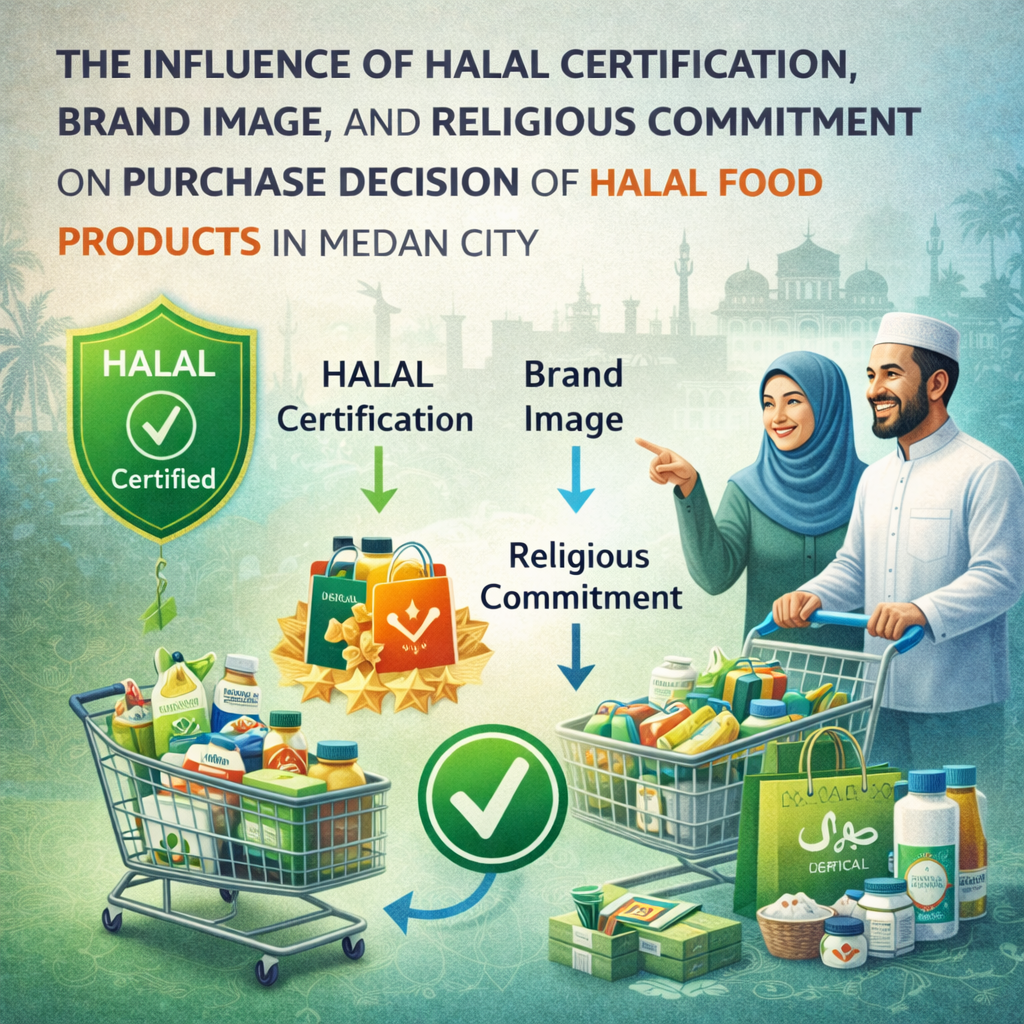
THE INFLUENCE OF HALAL CERTIFICATION, BRAND IMAGE, AND RELIGIOUS COMMITMENT ON PURCHASE DECISION OF HALAL FOOD PRODUCTS IN MEDAN CITY
DOI:
https://doi.org/10.47652/mjeb.v1i1.896Keywords:
Halal Certification, Brand Image, Religious Commitment, Purchase Decision, Halal Food Products, Islamic Marketing.Abstract
This study examines the influence of halal certification, brand image, and religious commitment on purchase decisions of halal food products among consumers in Medan City, Indonesia. Using a quantitative approach, data was collected from 200 Muslim consumers through structured questionnaires employing purposive sampling technique. The data was analyzed using Multiple Linear Regression Analysis with SPSS software. The results indicate that halal certification, brand image, and religious commitment simultaneously and partially have a significant positive influence on purchase decisions of halal food products. Religious commitment shows the strongest influence, followed by halal certification and brand image. The findings suggest that halal food producers and marketers in Medan should emphasize halal certification authenticity, build strong brand equity, and align their marketing strategies with religious values to enhance consumer purchase decisions. This study contributes to the growing body of knowledge on Islamic marketing and consumer behavior in the context of Indonesian Muslim consumers
References
Aaker, D. A. (1991). Managing Brand Equity: Capitalizing on the Value of a Brand Name. New York: The Free Press.
Abdul, M., Ismail, H., Hashim, H., & Johari, J. (2009). Consumer decision making process in shopping for halal food in Malaysia. China-USA Business Review, 8(9), 40-47.
Ahmed, A. (2008). Marketing of halal meat in the United Kingdom: Supermarkets versus local shops. British Food Journal, 110(7), 655-670.
Ajzen, I. (1991). The theory of planned behavior. Organizational Behavior and Human Decision Processes, 50(2), 179-211.
Alam, S. S., Mohd, R., & Hisham, B. (2011). Is religiosity an important determinant on Muslim consumer behaviour in Malaysia? Journal of Islamic Marketing, 2(1), 83-96.
Aziz, Y. A., & Chok, N. V. (2013). The role of halal awareness, halal certification, and marketing components in determining halal purchase intention among non-Muslims in Malaysia: A structural equation modeling approach. Journal of International Food & Agribusiness Marketing, 25(1), 1-23.
Bonne, K., & Verbeke, W. (2008). Religious values informing halal meat production and the control and delivery of halal credence quality. Agriculture and Human Values, 25(1), 35-47.
Keller, K. L. (1993). Conceptualizing, measuring, and managing customer-based brand equity. Journal of Marketing, 57(1), 1-22.
Khalek, A. A., & Ismail, S. H. S. (2015). Why are we eating halal – using the theory of planned behaviour in predicting halal food consumption among generation Y in Malaysia. International Journal of Social Science and Humanity, 5(7), 608-612.
Kotler, P., & Keller, K. L. (2016). Marketing Management (15th ed.). Upper Saddle River, NJ: Pearson Education.
Lada, S., Tanakinjal, G. H., & Amin, H. (2009). Predicting intention to choose halal products using theory of reasoned action. International Journal of Islamic and Middle Eastern Finance and Management, 2(1), 66-76.
Mukhtar, A., & Butt, M. M. (2012). Intention to choose halal products: The role of religiosity. Journal of Islamic Marketing, 3(2), 108-120.
Rahman, A. A., Asrarhaghighi, E., & Rahman, S. A. (2015). Consumers and halal cosmetic products: Knowledge, religiosity, attitude and intention. Journal of Islamic Marketing, 6(1), 148-163.
Schiffman, L. G., & Kanuk, L. L. (2010). Consumer Behavior (10th ed.). Upper Saddle River, NJ: Prentice Hall.
Worthington, E. L., Wade, N. G., Hight, T. L., Ripley, J. S., McCullough, M. E., Berry, J. W., ... & O'Connor, L. (2003). The Religious Commitment Inventory-10: Development, refinement, and validation of a brief scale for research and counseling. Journal of Counseling Psychology, 50(1), 84-96.
Yunus, N. S. N. M., Rashid, W. E. W., Ariffin, N. M., & Rashid, N. M. (2014). Muslim's purchase intention towards non-Muslim's halal packaged food manufacturer. Procedia-Social and Behavioral Sciences, 130, 145-154.



.png)